
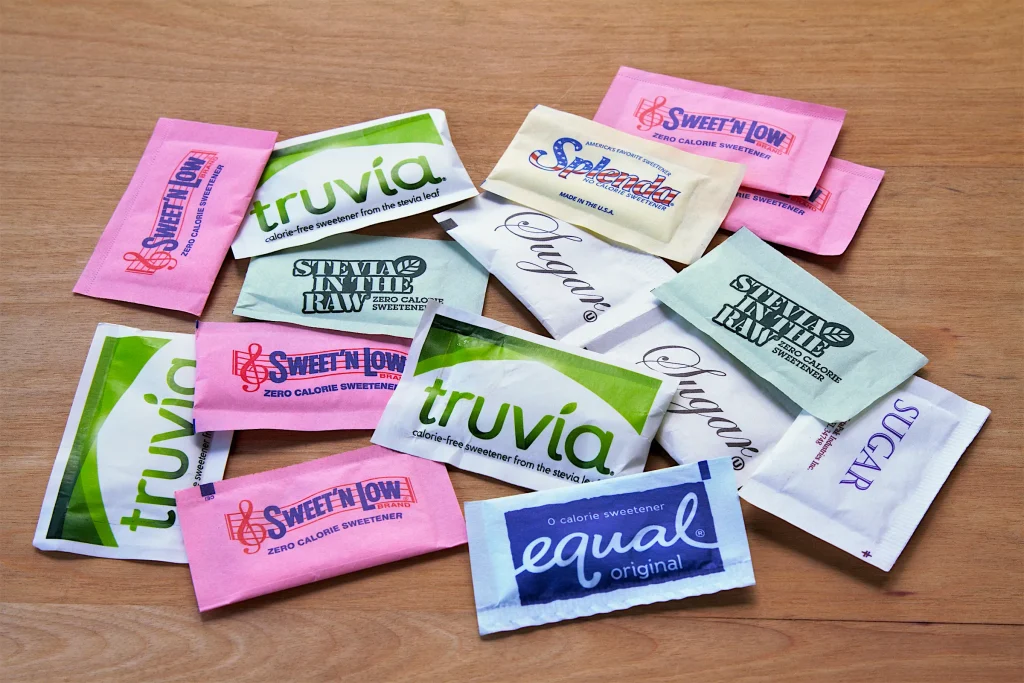
The World Health Organisation (WHO) has recently (15/05/2023) advised against the use of artificial sweeteners or what they term as ‘non-sugar substitutes (NSS)’ confirming that based on a review of extensive scientific research, NSS are not effective in weight-control and could actually pose a risk to health. The recommendation applies to all people EXCEPT individuals with pre-existing diabetes.
WHAT THE STUDIES SHOW
- NSS tend to be many times sweeter than sugar and therefore can increase your craving for sweet foods
- NSS have no nutritional value and so add no benefit to your diet
- While the specific cause has not been determined, studies show that consuming foods and beverages containing NSS does not help with long-term weight loss
- Studies suggest long-term use of NSS may lead to an increased risk of type 2 diabetes, cardiovascular diseases, and mortality in adults. Note that the WHO clearly states the evidence for the link is low quality
- There is some scientific evidence to show that artificial sweeteners may interfere with the gut microbiome, reducing the number and/or variety of good bacteria in the gut. However, much of the research has been conducted on animals so requires more investigation in human populations.
THE BOTTOM LINE
- Overall, there doesn’t seem to be any benefit to consuming artifical sweeteners and considerable downsides such as increasing the ‘sweet-tooth’, no proven link to long-term weight loss and possibly detrimental to gut health.
- However, the WHO’s advice doesn’t mean that you must avoid all NSS without exception. It is advice, rather than a warning and I believe the distinction is important. There is still a lot that is not known about the effects of NSS at the individual level so if you enjoy products that contain artificial sweeteners you don’t have to avoid them entirely but perhaps be mindful of the quantity you consume and be aware they add no known nutritional benefit to your diet.
REFERENCES
Basson, A.R., Rodriguez-Palacios, A. and Cominelli, F., 2021. Artificial sweeteners: history and new concepts on inflammation. Frontiers in Nutrition, 8, p.746247.
Bian, X., Chi, L., Gao, B., Tu, P., Ru, H. and Lu, K., 2017. The artificial sweetener acesulfame potassium affects the gut microbiome and body weight gain in CD-1 mice. PloS one, 12(6), p.e0178426.
Rios-Leyvraz, M., Montez, J. and World Health Organization, 2022. Health effects of the use of non-sugar sweeteners: a systematic review